Wednesday, March 8, 2017

Thursday March 9 Day 22

CHAPTER 12 Nationalism and Revolution around the World


Objective:
Students will be able to describe the independence struggles of the colonized regions of the world, including the roles of leaders, such as Sun-Yat-sen in China, and the roles of ideology and religions. As well as describe the effects of the war and resulting peace treaties on population movement, the international, economy, and shifts in the geographic, and political borders of Europe and the Middle East.

Rationale:
The transition from World War I ending and the various reactions which occurred around the world is important to understanding as a means of setting-up the economical and political foundation which led to World WAR II

Evidence:
Being able to list the factors that the Treaty of Versailles placed on the German people as well as the German Economy, as well as the impact of World Wide depression of the 1920, will enable students to connect these events into understanding the reasons WWII occurred.

___________________________________________________________________________________________

Essential Question - Does War settle anything?
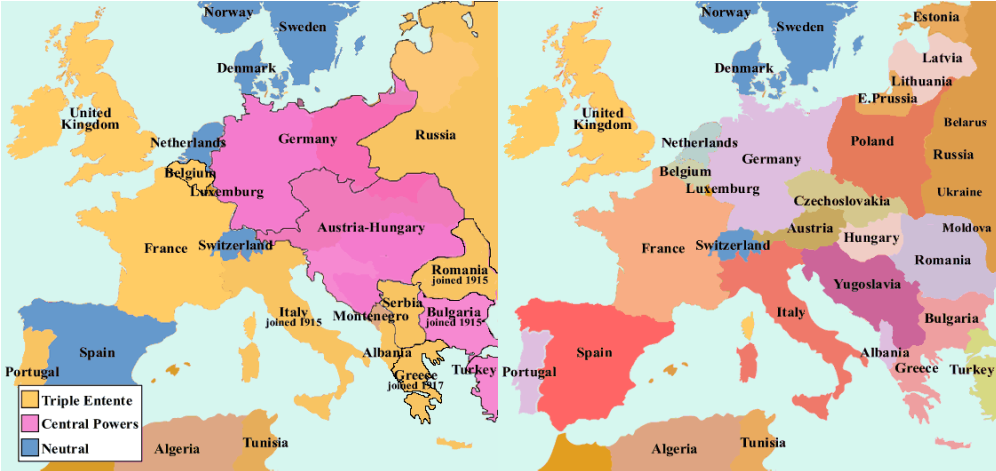


Before and After

Journal Entry -Voting age - ( 17 yr olds vote )
Read the article give your opinion

Turn-in Then and Now Project

Like the Timeline project, students will present their Then and Now project to the class

Chapter Outlines Schedule

Section #1 Friday March 10th  - Section #1
Section #2 Monday March 13th  - Section #2
Section #3 Tuesday March 15st  - Section #3
Section #4 Thursday March 17th  - Section #4
Section #5 Monday March 21st  - Section #5

Chapter 12 Practice Quizzes

The Sectional Quizzes will be due/turned-in on Tuesday the day of the test

Chapter 12 Sectional Presentation

The Sectional Summaries are to be used as resources to assist with understanding the material

Chapter 12 Test

Tuesday March 22nd

Tuesday, March 7, 2017

Tuesday March 7th Day 21

CHAPTER 11 World War 1 and The Russian Revolution


Objective:
Students will be able to analyze the arguments leaders from all sides of the Great War and the role of political and economic rivalries, ethnic and ideological conflicts, domestic discontent and disorder, and propaganda and nationalism in mobilizing the civilian population in support of "total war"
Examine the principal theaters of battle, major turning points, and the importance of geographic factors in military decisions and outcomes (eg., topography, waterways, distance, climate)

Rationale:
The "War to End all Wars" has many different interpretations as to its cause, its various changes and turns during, and its outcome. The effects of the war impacted many changes that occurred after its end (depression, WWI, etc). Students should understand the environment that led to the first war that was not relegated to one specific area but impacted an entire continent as well as other surrounding continents.

Evidence:
Being able to list the factors which led to the conflict, evaluate those factors for their merit or lack there of, and propose possible solutions that may have prevented the war, or changed the terms of the surrender which may have prevented or altered the World War that followed will allow students to gain insights as to how historical events were addressed.

___________________________________________________________________________________________


Journal Entry - No Journal Entry on Test Day.

Chapter 11 Test

Today March 8th

Sunday, March 5, 2017

Monday March 6th Day 20

CHAPTER 11 World War 1 and The Russian Revolution


Objective:
Students will be able to analyze the arguments leaders from all sides of the Great War and the role of political and economic rivalries, ethnic and ideological conflicts, domestic discontent and disorder, and propaganda and nationalism in mobilizing the civilian population in support of "total war"
Examine the principal theaters of battle, major turning points, and the importance of geographic factors in military decisions and outcomes (eg., topography, waterways, distance, climate)

Rationale:
The "War to End all Wars" has many different interpretations as to its cause, its various changes and turns during, and its outcome. The effects of the war impacted many changes that occurred after its end (depression, WWI, etc). Students should understand the environment that led to the first war that was not relegated to one specific area but impacted an entire continent as well as other surrounding continents.

Evidence:
Being able to list the factors which led to the conflict, evaluate those factors for their merit or lack there of, and propose possible solutions that may have prevented the war, or changed the terms of the surrender which may have prevented or altered the World War that followed will allow students to gain insights as to how historical events were addressed.

___________________________________________________________________________________________

Essential Question - Should we work with the Russians or treat them as Enemy?


Journal Entry - Interpret the quote below and explain its meaning.

It is true that liberty is precious; so precious that it must be carefully rationed. 
                                               Vladimir Lenin

Chapter Outlines Schedule

Section #5 Monday Mar 6th         Section #5 Textbook

Work on "MAIN - Causes of WWI" project
Causes Project - Due Tomorrow Tuesday March 8th

MAIN Presentation

Chapter 11 Practice Quizzes

The Sectional Quizzes will be due/turned-in on Tuesday the day of the test

Crash Course Video Assignment

Crash Course Video on World War I
Questions to be completed with the video - Questions Here

World War I Summary Video

( youtube video to be watched at home) - Summary video used for overall understanding

Russian Revolution Summary Video

( youtube video to be watched at home) - Summary video used for overall understanding

Chapter 11 Sectional Presentation

The Sectional Summaries are to be used as resources to assist with understanding the material

Chapter 11 Test

Tuesday March 8th

Thursday, March 2, 2017

Thursday Mar 2nd Day 19

CHAPTER 11 World War 1 and The Russian Revolution


Objective:
Students will be able to analyze the arguments leaders from all sides of the Great War and the role of political and economic rivalries, ethnic and ideological conflicts, domestic discontent and disorder, and propaganda and nationalism in mobilizing the civilian population in support of "total war"
Examine the principal theaters of battle, major turning points, and the importance of geographic factors in military decisions and outcomes (eg., topography, waterways, distance, climate)

Rationale:
The "War to End all Wars" has many different interpretations as to its cause, its various changes and turns during, and its outcome. The effects of the war impacted many changes that occurred after its end (depression, WWI, etc). Students should understand the environment that led to the first war that was not relegated to one specific area but impacted an entire continent as well as other surrounding continents.

Evidence:
Being able to list the factors which led to the conflict, evaluate those factors for their merit or lack there of, and propose possible solutions that may have prevented the war, or changed the terms of the surrender which may have prevented or altered the World War that followed will allow students to gain insights as to how historical events were addressed.

___________________________________________________________________________________________

Essential Question - Should we work with the Russians or treat them as Enemy?


Journal Entry - Clip about the attorney General and possible meeting with the Russians


Journal Entry - what should our relationship with Russian be? A play nice agreement or treat them as an advisory?

Chapter Outlines Schedule

Section #4 Today Mar 3rd      Section #4 Textbook
Section #5 Friday  Mar 4th         Section #5 Textbook

Thurs - Present Then & Now assignment on WWI 

Each student will present their "Then and Now" (at the front of the class with the projector showing their work)
Newspaper Layout Guide

Thursday - Finish MAIN presentation, submit timeline assignment, present timeline, work on "MAIN - Causes of WWI" project

Chapter 11 Practice Quizzes

The Sectional Quizzes will be due/turned-in on Thursday the day of the test

Crash Course Video Assignment

Crash Course Video on World War I
Questions to be completed with the video - Questions Here

World War I Summary Video

( youtube video to be watched at home) - Summary video used for overall understanding

Chapter 11 Sectional Presentation

The Sectional Summaries are to be used as resources to assist with understanding the material

Chapter 11 Test

Tuesday March 8th

Saturday, February 25, 2017

Monday Feb 27th Day 17

CHAPTER 11 World War 1 and The Russian Revolution


Objective:
Students will be able to analyze the arguments leaders from all sides of the Great War and the role of political and economic rivalries, ethnic and ideological conflicts, domestic discontent and disorder, and propaganda and nationalism in mobilizing the civilian population in support of "total war"
Examine the principal theaters of battle, major turning points, and the importance of geographic factors in military decisions and outcomes (eg., topography, waterways, distance, climate)

Rationale:
The "War to End all Wars" has many different interpretations as to its cause, its various changes and turns during, and its outcome. The effects of the war impacted many changes that occurred after its end (depression, WWI, etc). Students should understand the environment that led to the first war that was not relegated to one specific area but impacted an entire continent as well as other surrounding continents.

Evidence:
Being able to list the factors which led to the conflict, evaluate those factors for their merit or lack there of, and propose possible solutions that may have prevented the war, or changed the terms of the surrender which may have prevented or altered the World War that followed will allow students to gain insights as to how historical events were addressed.

___________________________________________________________________________________________
Essential Question - Nationalism?

Can pride in one's country become a bad thing?

Journal Entry - Nationalism...watch the interview with Nigel Farage (led Britain in the Brexit movement) - Nigel Farage on Tucker Carlson - Nationalism

Agree or disagree, explain why.

Mon - Presentation and start working on WWI Events project

Projects:

Significant Events Project

World War I - MAIN

Chapter Outlines Schedule

Section #3 - Tuesday Feb 28th      Section #3 Textbook
Section #4 - Thursday Mar 2nd       Section #4 Textbook
Section #5 - Monday Mar 6th         Section #5 Textbook

Chapter 11 Sectional Presentation

The Sectional Summaries are to be used as resources to assist with understanding the material

Chapter 11 Practice Quizzes

The Sectional Quizzes will be due/turned-in on Tuesday (March 7th) the day of the test

World War I Summary Video

( youtube video to be watched at home)
Crash Course Video on World War I
Questions to be completed with the video - Questions Here  - expect to submit these questions/answers by Tuesday the day of the test

Chapter 11 Test

Tuesday, March 7th

Wednesday, February 15, 2017

Thursday Feb 16th Day 16

CHAPTER 11 World War 1 and The Russian Revolution


Objective:
Students will be able to analyze the arguments leaders from all sides of the Great War and the role of political and economic rivalries, ethnic and ideological conflicts, domestic discontent and disorder, and propaganda and nationalism in mobilizing the civilian population in support of "total war"
Examine the principal theaters of battle, major turning points, and the importance of geographic factors in military decisions and outcomes (eg., topography, waterways, distance, climate)

Rationale:
The "War to End all Wars" has many different interpretations as to its cause, its various changes and turns during, and its outcome. The effects of the war impacted many changes that occurred after its end (depression, WWI, etc). Students should understand the environment that led to the first war that was not relegated to one specific area but impacted an entire continent as well as other surrounding continents.

Evidence:
Being able to list the factors which led to the conflict, evaluate those factors for their merit or lack there of, and propose possible solutions that may have prevented the war, or changed the terms of the surrender which may have prevented or altered the World War that followed will allow students to gain insights as to how historical events were addressed.

___________________________________________________________________________________________
Essential Question - Nationalism?


Can pride in ones country become a bad thing?
America has a nationalism problem. The U.S. has been described as the melting pot, a nation of immigrants and the Land of Opportunity. Indeed, the story we tell ourselves is that the American identity is rooted not in place, but in the acceptance of a common set of ideals, irrespective of race, religion or ethnicity. The politics of the last decade, however, have strained the notion of e pluribus unum, revealing among whites three definitions of the American nation that are exclusive rather than inclusive.
First come the “Unhyphenated Americans”. For decades, the Census Bureau has asked Americans “to what country does this person draw their heritage?” Among whites, German (17 percent), Irish (16 percent), and English (14 percent) are the most common responses. But about one in twelve whites Americans indicated they are just “Americans,” indicating an indigenous white identity unconnected to any particular European ethnicity. These Unhyphenated Americans are distinct. They are more likely to be fundamentalist Protestants. Nearly two thirds of them live in the Census South, and especially in Greater Appalachia.

The highest rate of “American” identity is among young rural whites with limited education. Recent surveys find that whites with an “unhyphenated” identity are increasingly voting very conservative and perceive a cultural threat from foreign influences. They also call themselves ethnic “Americans” for patriotic reasons. They favor a stronger national defense. And, they are more likely to think that an individual’s life chances are tied to their racial identity (what Michael Dawson called “linked fate“).


Journal Entry - Nationalism...it's a recent topic that is gaining a lot of news lately. What is Nationalism...

World War I - MAIN

Thurs - Presentation and start working on WWI Events project

Chapter Outlines Schedule

Section  #2 - Thursday  Feb 15th   Section #2 Textbook

February Break

Section #3 - Tuesday Feb 28th      Section #3 Textbook
Section #4 Thursday Mar 2nd       Section #4 Textbook
Section #5 Monday Mar 6th         Section #5 Textbook

Chapter 11 Sectional Presentation

The Sectional Summaries are to be used as resources to assist with understanding the material

Chapter 11 Practice Quizzes

The Sectional Quizzes will be due/turned-in on Tuesday (March 7th) the day of the test

World War I Summary Video

Chapter 11 Test

Tuesday, March 7th

Tuesday, February 14, 2017

Tuesday Feb 14th Day 15

CHAPTER 11 World War 1 and The Russian Revolution


Objective:
Students will be able to analyze the arguments leaders from all sides of the Great War and the role of political and economic rivalries, ethnic and ideological conflicts, domestic discontent and disorder, and propaganda and nationalism in mobilizing the civilian population in support of "total war"
Examine the principal theaters of battle, major turning points, and the importance of geographic factors in military decisions and outcomes (eg., topography, waterways, distance, climate)

Rationale:
The "War to End all Wars" has many different interpretations as to its cause, its various changes and turns during, and its outcome. The effects of the war impacted many changes that occurred after its end (depression, WWI, etc). Students should understand the environment that led to the first war that was not relegated to one specific area but impacted an entire continent as well as other surrounding continents.

Evidence:
Being able to list the factors which led to the conflict, evaluate those factors for their merit or lack there of, and propose possible solutions that may have prevented the war, or changed the terms of the surrender which may have prevented or altered the World War that followed will allow students to gain insights as to how historical events were addressed.

___________________________________________________________________________________________
Essential Question - Can war be avoided?


Sanctuary Cities in the USA.....should there be any? Should there be sanctuary cities during wartime?


Journal Entry - President Trump recently signed an executive order impacting Immigration (the news mainly covered the people entering the country through the airports)
but in-country immigrants are also affected, and the issue of sanctuary cities is again a hot topic. 1st review the actual Executive Order signed by Trump, then review the Pro and Con of Sanctuary Cities link, then write your support for one side (include 3 reasons for your support of the side you select)

What was the Executive Order signed by President Trump - Executive Order
What are 3 Pro's and Cons in relation to Sanctuary Cities - Pro and Con Sanctuary City

World War I - MAIN

Tues - Presentation and map-work setting the foundation for WWI

Woodrow Wilson Biography (answer the 3 questions at the end)
Introduction to WWI article and Questions (answer the questions listed at the end)

Chapter Outlines Schedule

Section  #2 - Thursday  Feb 15th   Section #2 Textbook

February Break

Section #3 - Tuesday Feb 28th      Section #3 Textbook
Section #4 Thursday Mar 2nd            Section #4 Textbook
Section #5 Monday Mar 6th         Section #5 Textbook

Chapter 11 Sectional Presentation

The Sectional Summaries are to be used as resources to assist with understanding the material

Chapter 11 Practice Quizzes

The Sectional Quizzes will be due/turned-in on Tuesday (March 7th) the day of the test

World War I Summary Video

Chapter 11 Test

Tuesday, March 7th